Tuesday, August 17, 2010

At Chowpatty

None of the following pictures have been shot by me.
I think, its important for me to mention that I cant possibly upload all the pictures that they've taken and also that the ones I upload will be based on a bit of a bias on my part (at some level). I haven't cropped or digitally tampered with the images either.

But here they are : Enjoy!


After this session, I spent the next one on showing them all the photos they had clicked on my computer screen. We discussed which ones were good and which ones dint quite work and why.

I have to really break things down and simplify them for the kids, for example, instead of getting into the rule of thirds, I have just asked them to think of the placement of the subject in the photo. Why do they always put the subject in the middle? Why not on the side or anywhere else in the frame?

I also told them not to cut off peoples heads and limbs! Now, they've started noticing these small things. By the time we reached the thirds kids photos, they started to point at the picture and say : "usne dekho, usko pura kaat diya!!"

Another thing, I've told them to do, is start thinking why they're clicking certain things and from where. They must use their whole body instead of just their hands to get a larger range of angles!

I also did a small cropping exercise with them.
What I did, was told each child to pick two of their favorite pictures from the lot and then cropped them, to make them look more composed. I then showed them the differences between these images, to make them realize, how even though they are clicking cool subjects, they may not be composing the frame in the best way possible. 


Tuesday, August 10, 2010

Pin Hole Cameras & Chowpatty

Weekday Batch

The same Pin Hole camera exercise was repeated. The weekday batch is alot smaller - its just 8 kids. Out of which 3 dint show up due to various reasons.


Testing the Camera


Noddy Camera


Light Camera


Popeye Camera


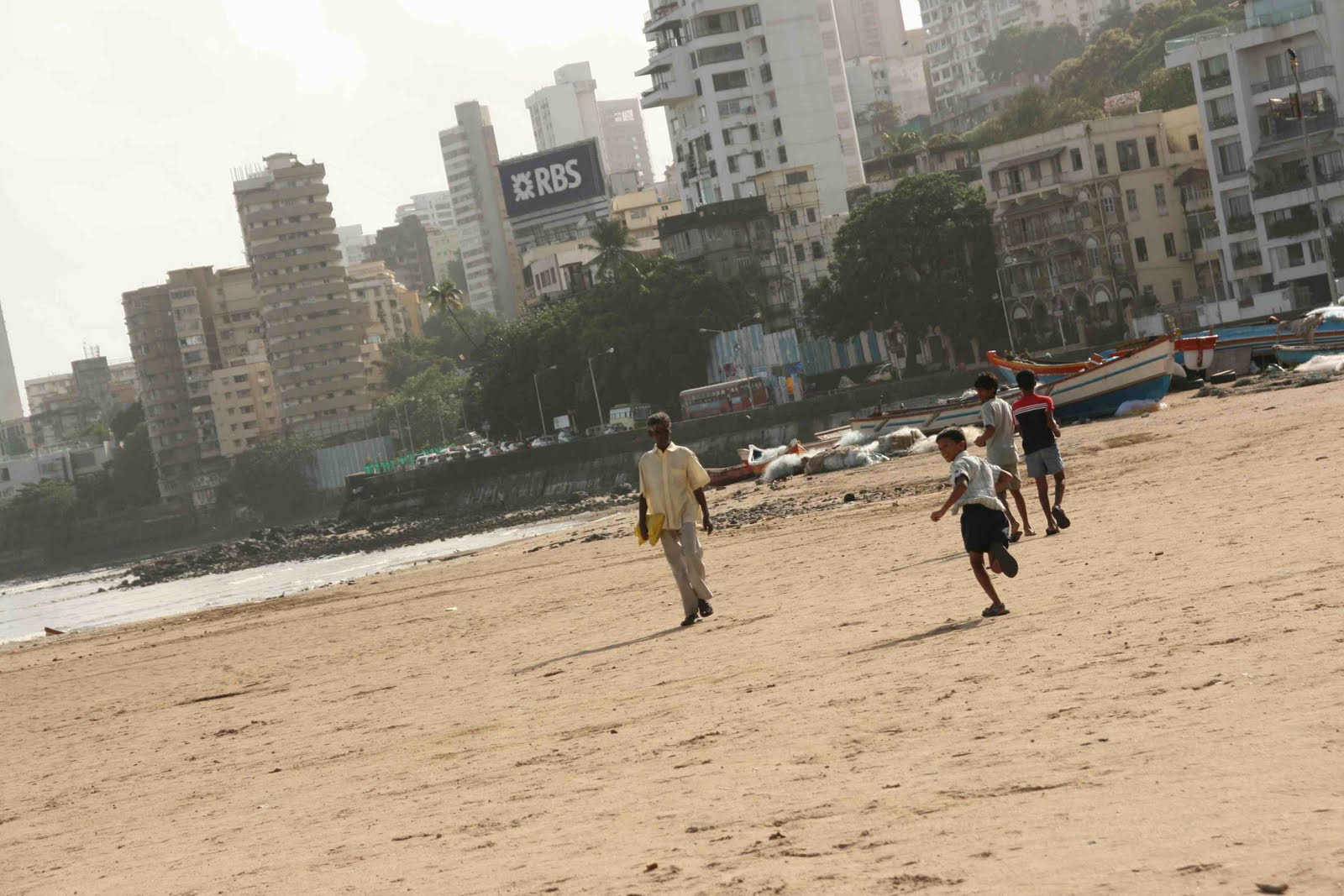
I tried to take advantage of this fact, and asked the kids if they want to go somewhere. "Chalo chowpatty ghoomne chalte hain?" asked Smitesh. And so thats exactly what we did. I showed them the basic functions of the camera, and took them there.

Chowpatty is not too far away from where they live. About a 20 minute bus ride. Hence this is part of their extended space as they come here on sundays and bank holidays to play and relax. They love the beach, and its really sad that I don't visit it often enough. Im glad they initiated going there, I feel like I rediscovered it through them!


"Dekho, Ankesh Hero-giri kar raha hain!"


Rishikesh is quite the Graphic Artist! He formulated a form in which you can find all the letters of his name if you look closely!


I still need to go through the cameras and sort out all the pictures they took, will share them with you shortly.

Social Practice


Art and Social Practice
Through the use of various strategies including "urban interventions, utopian proposals, guerrilla architecture, "new genre" public art, social sculpture, project-based community practice, interactive media, service dispersals, and street performance."[1] the primary material of social practice is person-to-person exchange, interaction, or participation. These situations, organizations and events can involve various media including photographyvideodrawingtextsoundsculpture, and performance art.
Within the art making process, the practice emphasizes people in relationships to each other and their surroundings, "focusing on engagement and accountability between the audience and the artist"[2]. Distinct from modern art of the 20th century, social practice builds on a variety of contemporary art movements, including public artInstitutional Critiqueinteractive artperformance art, and environmental art[3]. It is distinct from academic art or the high arts movements in that it does not require any association with formal art theory or training. Breaking away from the conventions of any particular structured aesthetic theory, social practice maintains the intention of creativity while incorporating elements of sociology, anthropology, social work, environmentalism, journalism and community outreach.
Through diverse art strategies, the field focuses on topics such as aesthetics, ethics, collaboration, persona, media strategies, and social activism; art strategies may include urban interventions, utopian proposals, guerrilla architecture, "new genre" public art, social sculpture, project-based community practice, interactive media, service dispersals, and street performance.

Source - Wiki

Monday, August 9, 2010

Kids and How we must give them time to flip out before they actually do something.

I must admit, I had a lot of hope for the last exercise I had in mind for the kids to do! I explained to them the basic functions of the camera :
Turning Power on / off
Flash on / off
Recording and Viewing Mode

I did not know, that they were going to go nuts, which well, is absolutely silly on my part.

I gave them the cameras telling them that they must each go find an object that they like and dislike. This object would need to be clicked in its environment in as many angles or placements as possible.

They were all really excited about it and ran off into the community to go capture these shots.

Well, no, NOT REALLY!

They came back with all sorts of random pictures having completely forgotten about the exercise. Either that, or one out of all the images was "something they liked or disliked."

Don't get me wrong! I am very amused and I'd love to share with you a few of the images that they did click that have nothing to do with the activity.  I'm taking this enthusiasm to capture friends and family as an insight into the social belonging these kids feel by clicking such pictures. And by showing these pictures, they are only spreading joy and smiles through the community.

First Clicks

Overnight in Bangalore

This is a summary of my second review with my Panel at Srishti.

In this review, I discussed my plans for the next few classes and the feedback I received has helped me change the structure of what will follow.

- Pay less attention to technique and more to expression itself.

- Let the children tell stories rather than be told what to do.

- Focus on urging them to shoot images that capture their everyday life and not just things that amuse them.

- How does the child see the world? I must not try and enforce my aesthetics on them, rather, appreciate the vision they have, without being directed on composition and perspective.

- What is the net importance of the subject rather than the realistic one?

- What is reality for them?

- What do the dream of? The difference between dreams and dream vision.

- Can I get them to create a narrative with the pictures?

- The final outcome of the exhibition should treat them as CO-CREATORS. It is important not to focus on each child and their images, but make it more of a community pool of images so all of them are enthusiastic about adding to this pool and being a part of it.

A thank you to Ravindra, Sabina and Sanjay - my panel.

I would also like to thank Geetanjali Sachdev, Rustam Vania and Ampat Varghese who have been giving me additional guidance even though they are not on my panel. Will be sharing their feedback soon on the new resources tab I must create!

Pin Hole Cameras

Weekend Batch

I introduced the idea of PHOTO-GRAPHY being LIGHT-WRITING.

I want the kids to start looking at photography not as work, but a language in itself. Something like Hindi or Marathi, explaining to them that the same way they use words to express themselves in a language, light writing is a new language and they can use images to express themselves.

In order for them to understand how this light works, I decided that getting them to make their own pin hole cameras would be a fun exercise, during which, the basic details of the colors Black and White can be explained.

Also, the fact that images are seen by the eye up-side-down and the brain then flips it. The pin hole camera is the best way to explain this fact!

We opened up old cartons found easily at the store nearby and started creating the cameras in groups.

Painting the inside of the box black, to understand how black doesn't reflect light and hence will help in capturing a clearer image.


Clearly I am unable to manage the enthusiasm with which these children respond to the activites. They were very amused by the masking tape and decided it would look good on my face. I guess, their sense of aesthetics is very different from mine!


Masking the box with duct tape so that no light escapes through tiny crevices. 


Each group had to come up with a name for themselves. Are you as surprised as I was?


The proud Camera Manufacturers!